

Last week at Boulder Startup Week, Eli and I ran a workshop around a problem I keep seeing everywhere:
AI did not just make it easier to build software.
It made it way easier to generate more ideas than a team can responsibly process.
That sounds like a good problem until your roadmap turns into a pile: half-prompts, half-products, internal tools, client ideas, automations, demos, experiments, all competing for the same attention. Everyone can see the possibility. Nobody is quite sure what is real enough to build.
That is the part people underestimate.
The bottleneck is not imagination anymore. The bottleneck is judgment.
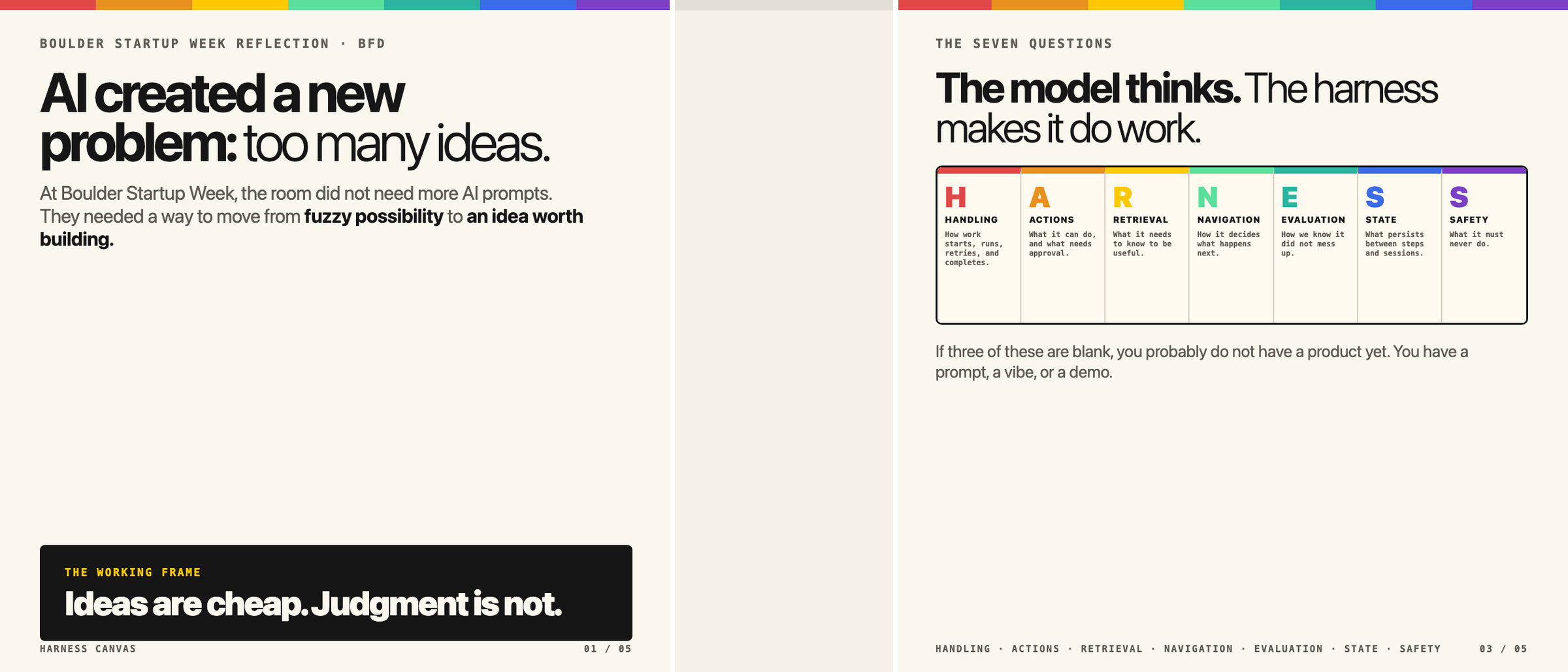
Ideas are cheap. Judgment is not.
A few years ago, having the idea was still a meaningful chunk of the work. Could we build this? Could we prototype it? Could we afford the engineering time to find out?
AI changed that equation. You can get to something that looks like a demo very quickly now. You can generate interface options, implementation plans, rough code, workflow automations, research summaries, and pitch language in an afternoon.
Useful? Absolutely.
Also deeply confusing.
Because once every idea can look plausible, plausible stops being a useful filter.
The room at Boulder Startup Week did not need more AI prompts. It did not need another list of tools. It needed a way to move from fuzzy possibility to an idea worth building.
That is what HARNESS is for.
The confused state is real
Most teams I talk to are somewhere in the same fog.
They know AI matters. They know there is value somewhere in their workflows, customer experience, internal operations, product surface, sales process, or support system. They may even have a list of twenty things they could do.
But the list is messy.
One idea is a feature. One is a product. One is really just a prompt. One is a workflow improvement. One requires access to three systems nobody has mapped. One sounds amazing until you ask how it will be evaluated. One is already possible with existing software. One might be a company.
That is the confused state.
And if you skip straight from that state into building, you usually do one of two things:
- You build a demo that feels magical for ten minutes and then collapses under real workflow pressure.
- You overbuild a platform around an idea nobody has made concrete enough to evaluate.
Neither failure means the team is dumb. It means the team did not have a good intermediate step.
HARNESS is the intermediate step
HARNESS is a canvas exercise we have been using to take a fuzzy AI/product idea and make it concrete enough to evaluate.
Not perfect. Not fully scoped. Not ready for a six-month roadmap.
Just real enough that a team can look at it together and say, "Yes, this is worth the next move," or "No, this is still just a vibe."
The acronym gives us seven questions:
| Letter | Question |
|---|---|
| H - Handling | How does the work start, run, retry, and complete? |
| A - Actions | What can the system actually do, and what needs approval? |
| R - Retrieval | What does it need to know to be useful? |
| N - Navigation | How does it decide what happens next? |
| E - Evaluation | How do we know it did not mess up? |
| S - State | What persists between steps and sessions? |
| S - Safety | What must it never do? |
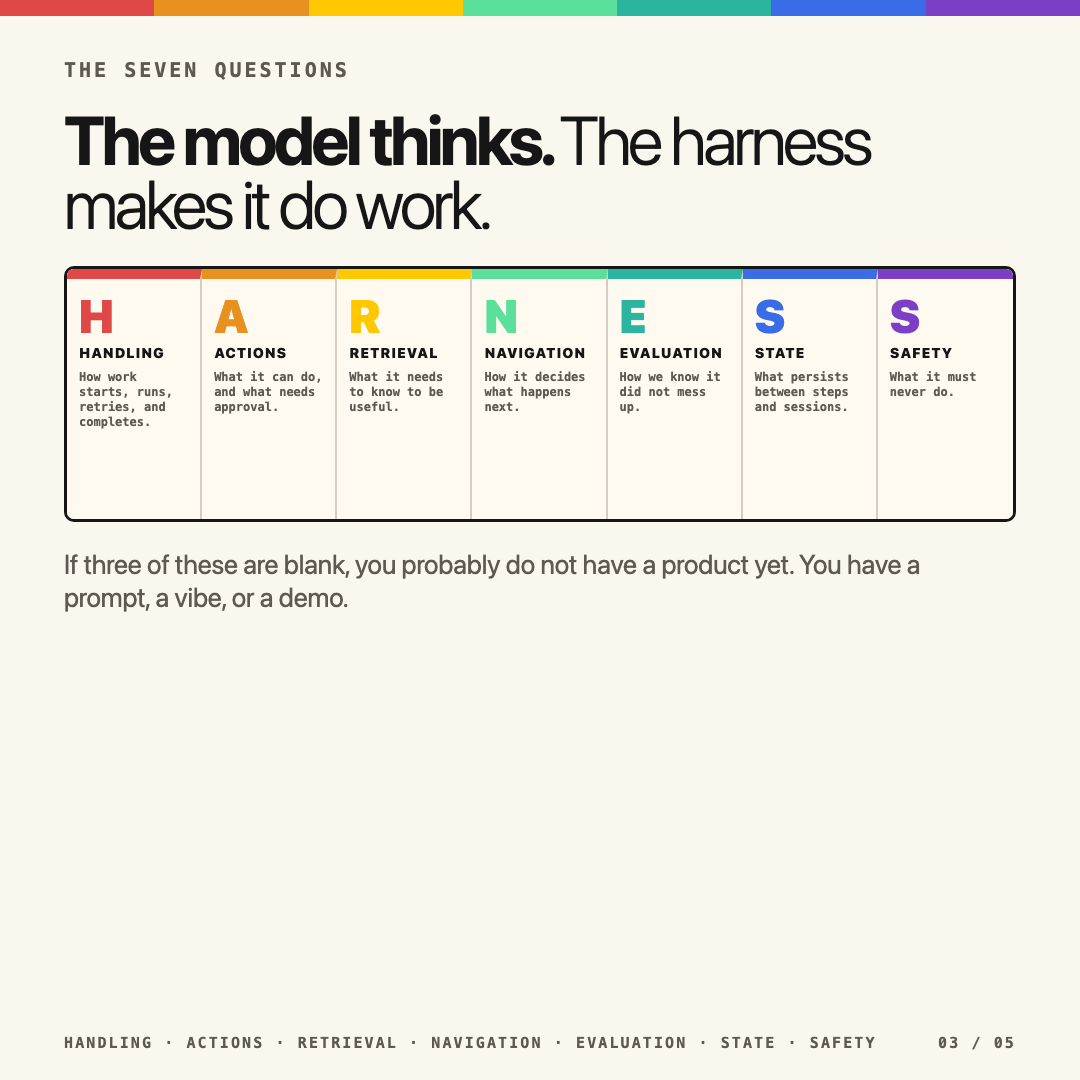
If three of those are blank, you probably do not have a product yet.
You have a prompt, a vibe, or a demo.
That is not an insult. It is actually useful information. A prompt can become a product. A demo can become a system. A vibe can become a company. But they do not become those things by pretending the missing pieces are details.
The missing pieces are the product.
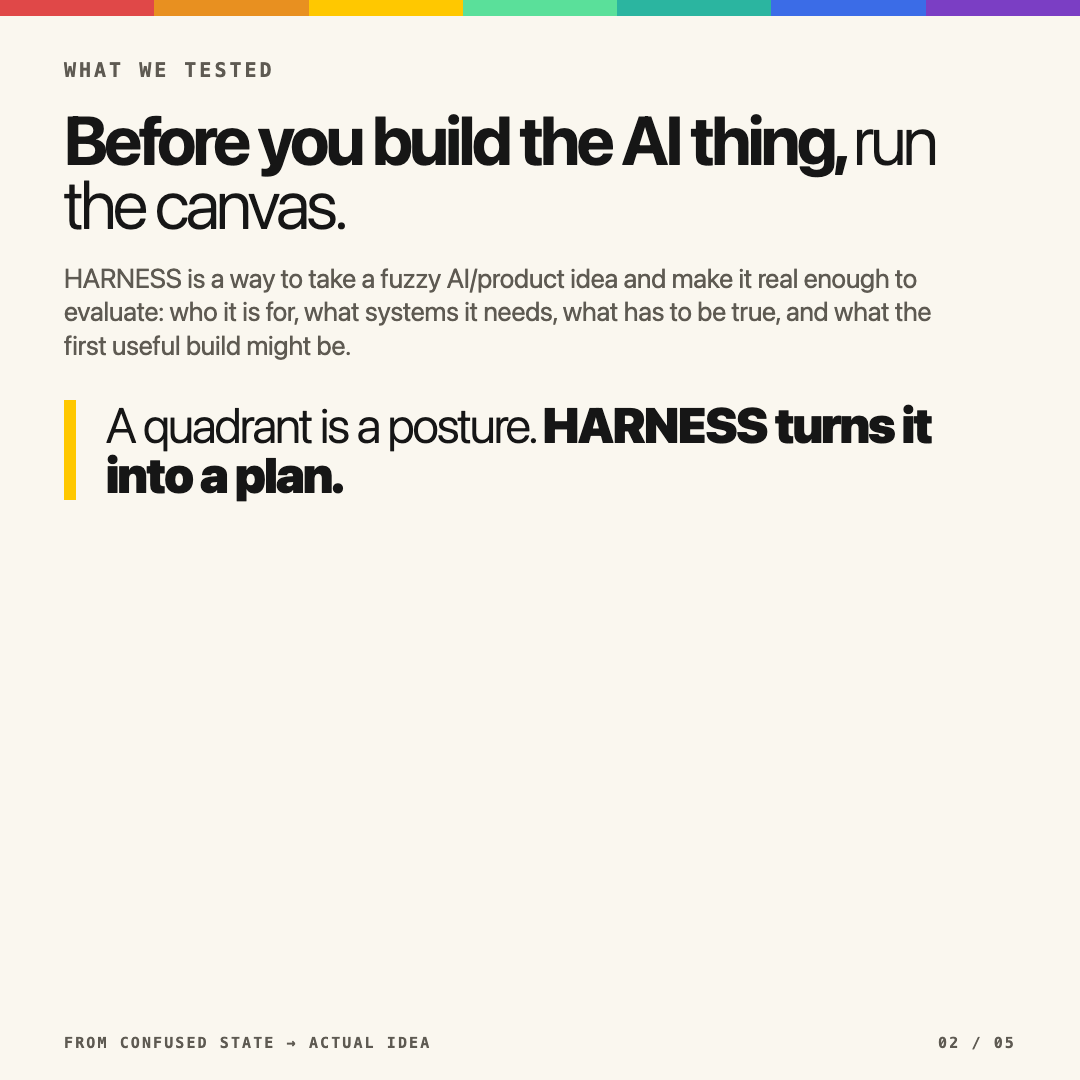
A quadrant is a posture. HARNESS turns it into a plan.
One of the lines that came out of the workshop was this:
A quadrant is a posture. HARNESS turns it into a plan.
A lot of strategy work helps teams decide where an idea sits. Is this urgent or important? Is this a build, buy, validate, or ignore? Is this low effort or high impact?
That is helpful, but it is not enough.
A quadrant can tell you where to stand. It does not tell you what has to be true for the idea to work.
HARNESS forces the system questions.
What data does this thing need? What action is it allowed to take? What does approval look like? What counts as success? What happens when it is wrong? What should it remember? What should it forget? Where does the human stay in the loop?
Those are not implementation details. Those are the difference between an AI trick and an AI product.
The first useful build
The other point we kept coming back to: the goal is not to produce a prettier brainstorm.
The goal is to find the first useful build.
Not the big platform. Not the perfect agent architecture. Not the future-state product vision with every integration wired in.
The first useful build.
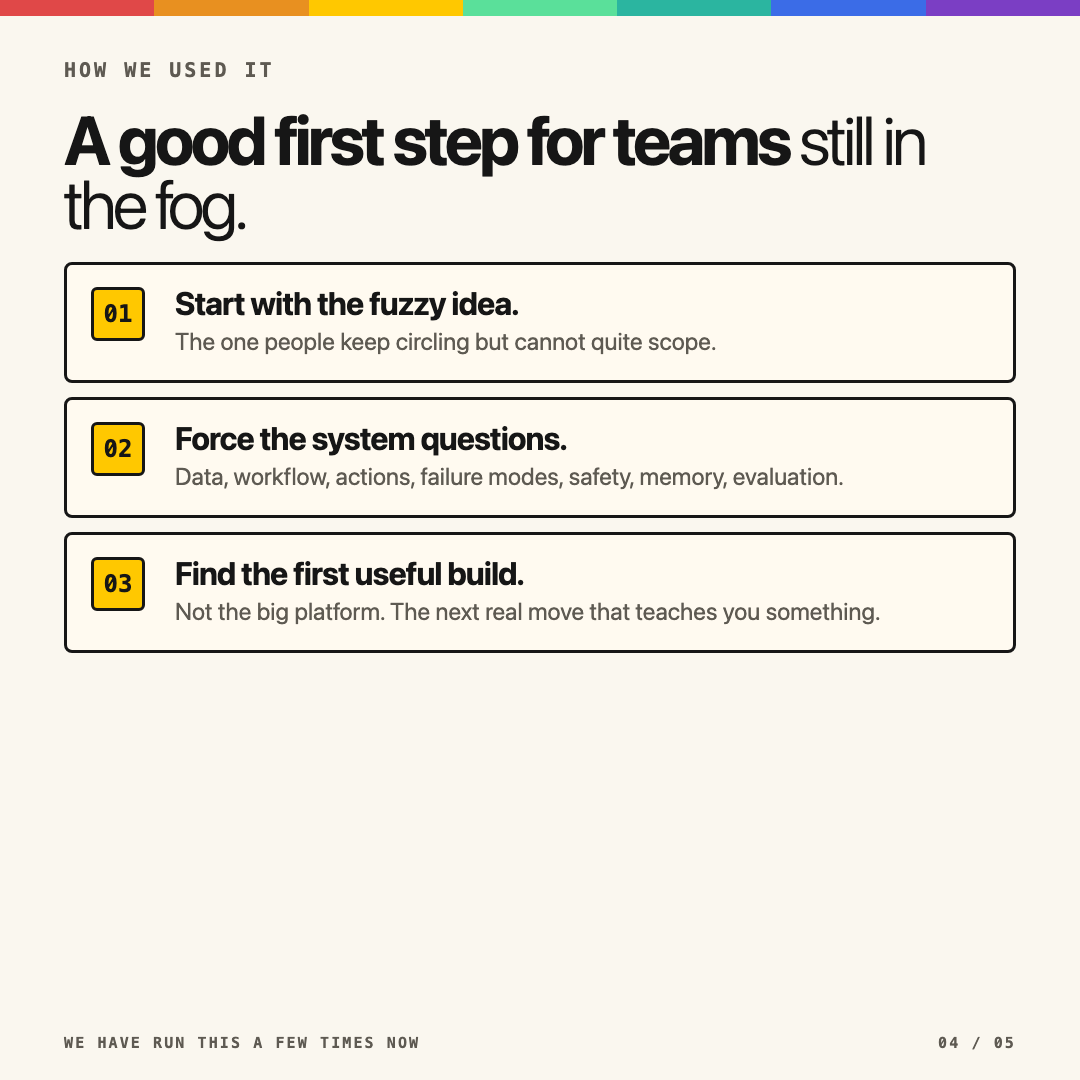
That might be a workflow prototype. It might be a thin internal tool. It might be a concierge version with a human behind the curtain. It might be a small automated step inside a larger manual process. It might be a throwaway demo whose only job is to answer one risky question.
The point is to move from "we should do something with AI" into an idea you can actually decide on.
Because that is where momentum starts.
What we have learned running it
We have run this a few times now, and the pattern is pretty consistent.
Teams do not struggle because they lack ideas.
They struggle because the ideas arrive at the wrong altitude.
Too abstract and nobody knows what to build. Too specific and everyone gets trapped debating interface details before the system makes sense. Too technical and the business owner checks out. Too business-y and the engineers quietly see five impossible dependencies nobody has named.
The canvas gives everyone a shared object.
Product can talk about the user. Engineering can talk about the systems. Leadership can talk about risk. Design can talk about the workflow. Everyone can see the blanks.
And the blanks are the whole point.
A blank in HARNESS is not a failure. It is a conversation you are finally having early enough to matter.
The strong point
AI has made it cheap to generate ideas that sound good.
It has not made it cheap to know which ideas deserve the team's attention.
That is the work now.
The teams that win will not be the teams with the longest list of AI experiments. They will be the teams with the clearest mechanism for turning fog into judgment, judgment into a first useful build, and a first useful build into evidence.
That is what we were trying to get at in the workshop.
Bring one fuzzy idea. Put it through the canvas. Find the blanks. Decide what has to be true. Build the smallest version that teaches you something.
That is a good first step.
And right now, a good first step is worth a lot.
%22%2F%3E%3Cpath%20d%3D%22M0%20110h1200M0%20375h1200M0%20640h1200M180%200v750M600%200v750M1020%200v750%22%20stroke%3D%22rgb(244%20241%20234)%22%20stroke-opacity%3D%22.13%22%20stroke-width%3D%222%22%2F%3E%3Crect%20x%3D%2288%22%20y%3D%2286%22%20width%3D%221024%22%20height%3D%22578%22%20fill%3D%22none%22%20stroke%3D%22rgb(244%20241%20234)%22%20stroke-opacity%3D%22.32%22%20stroke-width%3D%223%22%2F%3E%3Ctext%20x%3D%22110%22%20y%3D%22150%22%20fill%3D%22rgb(244%20241%20234)%22%20font-family%3D%22Montserrat%2C%20Arial%2C%20sans-serif%22%20font-size%3D%2228%22%20font-weight%3D%22800%22%20letter-spacing%3D%228%22%3ECLAUDE%20CODE%3C%2Ftext%3E%3Ctext%20x%3D%22110%22%20y%3D%22572%22%20fill%3D%22rgb(244%20241%20234)%22%20font-family%3D%22Montserrat%2C%20Arial%2C%20sans-serif%22%20font-size%3D%2276%22%20font-weight%3D%22900%22%3EBLACK%20FLAG%3C%2Ftext%3E%3Ctext%20x%3D%22110%22%20y%3D%22635%22%20fill%3D%22rgb(244%20241%20234)%22%20font-family%3D%22Montserrat%2C%20Arial%2C%20sans-serif%22%20font-size%3D%2252%22%20font-weight%3D%22700%22%3EJOURNAL%3C%2Ftext%3E%3CforeignObject%20x%3D%22110%22%20y%3D%22210%22%20width%3D%22940%22%20height%3D%22230%22%3E%3Cdiv%20xmlns%3D%22http%3A%2F%2Fwww.w3.org%2F1999%2Fxhtml%22%20style%3D%22font-family%3AMontserrat%2CArial%2Csans-serif%3Bfont-size%3A50px%3Bfont-weight%3A800%3Bline-height%3A1.02%3Bcolor%3Argb(244%20241%20234)%3Bletter-spacing%3A0%22%3EWhat%20a%20Year%20of%20Claude%20Code%20Trails%20Tells%20You%20About%20Your%20Team%3C%2Fdiv%3E%3C%2FforeignObject%3E%3C%2Fsvg%3E)

%22%2F%3E%3Cpath%20d%3D%22M0%20110h1200M0%20375h1200M0%20640h1200M180%200v750M600%200v750M1020%200v750%22%20stroke%3D%22rgb(244%20241%20234)%22%20stroke-opacity%3D%22.13%22%20stroke-width%3D%222%22%2F%3E%3Crect%20x%3D%2288%22%20y%3D%2286%22%20width%3D%221024%22%20height%3D%22578%22%20fill%3D%22none%22%20stroke%3D%22rgb(244%20241%20234)%22%20stroke-opacity%3D%22.32%22%20stroke-width%3D%223%22%2F%3E%3Ctext%20x%3D%22110%22%20y%3D%22150%22%20fill%3D%22rgb(244%20241%20234)%22%20font-family%3D%22Montserrat%2C%20Arial%2C%20sans-serif%22%20font-size%3D%2228%22%20font-weight%3D%22800%22%20letter-spacing%3D%228%22%3EPLAYBOOK%3C%2Ftext%3E%3Ctext%20x%3D%22110%22%20y%3D%22572%22%20fill%3D%22rgb(244%20241%20234)%22%20font-family%3D%22Montserrat%2C%20Arial%2C%20sans-serif%22%20font-size%3D%2276%22%20font-weight%3D%22900%22%3EBLACK%20FLAG%3C%2Ftext%3E%3Ctext%20x%3D%22110%22%20y%3D%22635%22%20fill%3D%22rgb(244%20241%20234)%22%20font-family%3D%22Montserrat%2C%20Arial%2C%20sans-serif%22%20font-size%3D%2252%22%20font-weight%3D%22700%22%3EJOURNAL%3C%2Ftext%3E%3CforeignObject%20x%3D%22110%22%20y%3D%22210%22%20width%3D%22940%22%20height%3D%22230%22%3E%3Cdiv%20xmlns%3D%22http%3A%2F%2Fwww.w3.org%2F1999%2Fxhtml%22%20style%3D%22font-family%3AMontserrat%2CArial%2Csans-serif%3Bfont-size%3A50px%3Bfont-weight%3A800%3Bline-height%3A1.02%3Bcolor%3Argb(244%20241%20234)%3Bletter-spacing%3A0%22%3EThe%20Black%20Flag%20Playbook%3A%20Six%20Principles%20for%20Shipping%20with%20AI%3C%2Fdiv%3E%3C%2FforeignObject%3E%3C%2Fsvg%3E)